November 23, 2026 | by Captain Ross Milroy
Miami Waterfront Guide: Canal Front vs. Open Bay Living
Every waterfront listing in Miami leads with the same three talking points: square footage, unobstructed bay views, and whether you have fixed bridges to the ocean. Real estate agents love those metrics because they are easy to see from the back patio and easy to speak to as a layman.
What gets left out of the brochure is everything happening underneath your boat, behind the seawall, and out in the channel once the weekend hits. I have spent years running vessels through every corner of Biscayne Bay and its tributary canals, and I can tell you firsthand that crossing from an interior canal lot to an open bay lot, even on the exact same barrier island like Bay Harbor Islands, Indian Creek, or Normandy Shores, changes almost every single rule of living on the water.
Whether you are docking a 30-foot center console or you don't even own a boat and just want to launch a paddleboard before work, the water behaves completely differently depending on which side of the island you buy and your specific location.
Water Quality: Flow-Through vs. Dead-End Canals in Miami
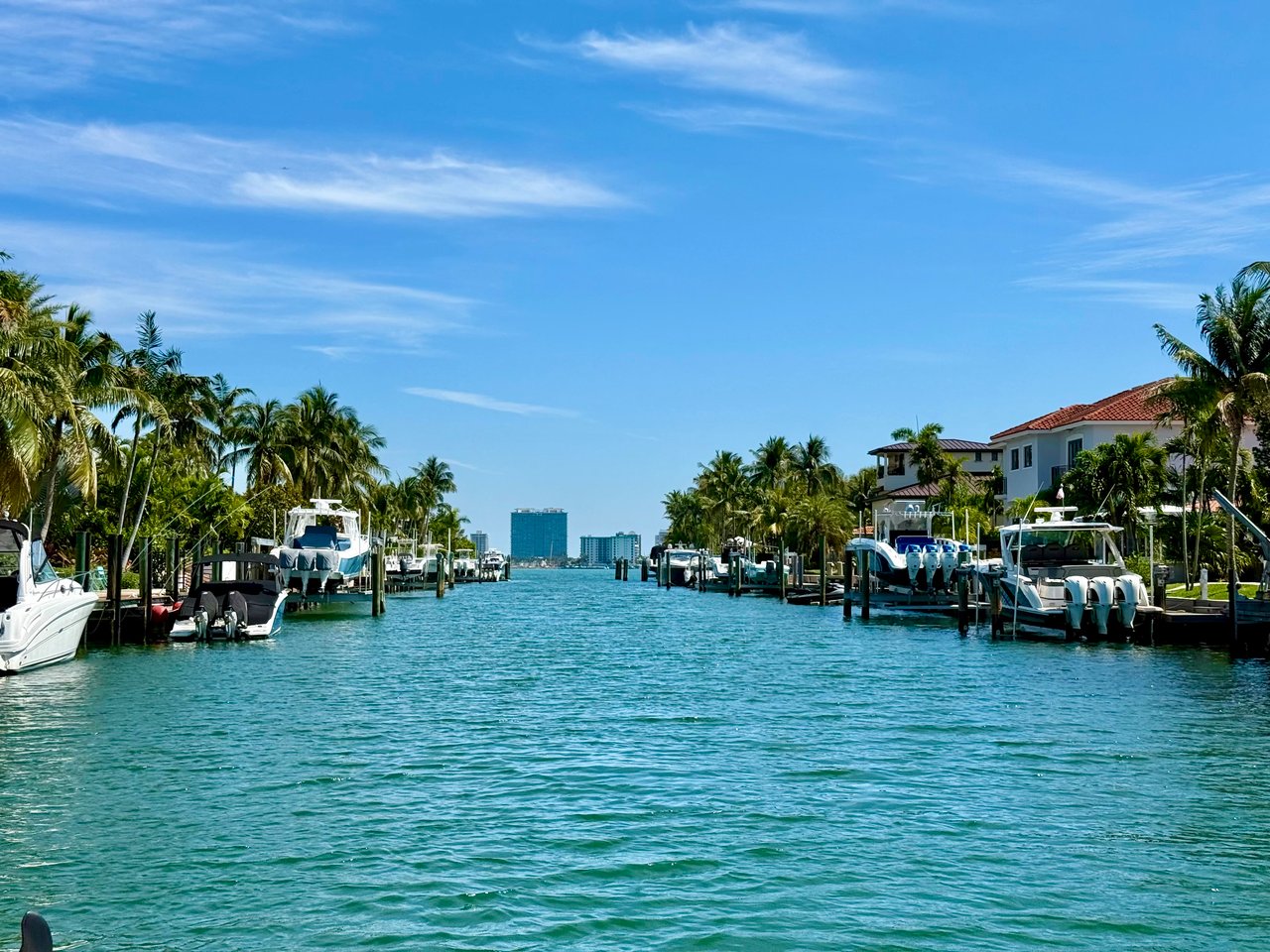
When buyers look at a canal lot, they usually focus on width and bridge clearance. What I look at first is whether the canal actually breathes. A flow-through canal opens to the bay or the Intracoastal at both ends, meaning the tide flushes it out twice a day. A dead-end finger canal is a cul-de-sac for water. Whatever blows in stays in. Prevailing southeast winds and incoming tides push floating sargassum, street runoff, and debris straight to the back of the canal, where it sits and cooks in the heat. If you bought that house dreaming of launching a kayak or paddleboard off the dock, a stagnant dead-end canal lot will definitely impact your usage and enjoyment.
If you do look at a dead-end canal, pay close attention to the turning basin. Lots sitting on the basin or near intersecting canals give you wider water views and make turning a larger boat vastly easier, especially if you are coming alongside a slip against a crosswind. The catch is that you become the turnaround spot for the entire street, meaning you absorb some prop wash and maneuvering wake of larger vessels that come down the canal.
Further west up the canal systems, you also run into the freshwater flood-control network. When the South Florida Water Management District opens the spillways during the rainy season, your saltwater canal turns brackish overnight. Full saltwater on the open bay is more predictable, you stay on top of your zincs and bottom paint and you're fine. Brackish water shifts pH and salinity constantly, which breeds different marine growth and eats away at underwater metals in ways most homeowners never anticipate.
My waterfront residence is located in a predominantly brackish water environment. While I love our resident spotted eagle ray, juvenile tarpon or pompano, we do have to watch out for the occasional saltwater crocodile swimming in our canal system.
Boat Draft, Shoals, and Low-Tide Depth at the Dock
Listings love to advertise "deep water," which usually means someone took a depth reading down the center of the channel. That number does you zero good when you are trying to get off your boat lift at dead low tide in September.
Biscayne Bay swings roughly two to two-and-a-half feet on a normal tide, and a strong winter west wind can push water out of the bay entirely. Open bay lots deal with shifting sandbars and shoals; one heavy storm can move sediment right across your approach overnight. Canal lots have the opposite problem: silt and runoff build up directly along the seawall, especially near storm drain outfalls, shallowing out the exact spot where your boat needs to sit. Always check the depth right at the pilings at low tide, not out in the middle of the waterway.
Docking on the ICW vs. Interior Canals and Point Lots
If you run your own boat, docking on the open bay or along the Intracoastal Waterway (ICW) will test your patience, pilot skills and your gelcoat. The ICW moves serious water volume. Try backing a boat into a slip along the Intracoastal on a ripping outgoing tide with a 12-knot breeze pushing across your beam, and you will quickly understand why people pay significantly extra for joysticks, bow or stern thrusters. In general, interior canals block the wind and kill the current, making single-handed docking dramatically easier. Your only real headache in a canal is tight quarters and inconsiderate neighbors. If your neighbor across a 70-foot waterway puts a wide-beam boat in their dock, your margin for error shrinks dramatically.
One of the most common issues that I have to explain to clients, local boat and homeowners, is the rights of the use of the waterway. Under Miami-Dade County Code, Section 24-48, canal rights-of-way state the following: They generally apply a standard where the combined protrusion of the dock, pilings, and the moored vessel cannot exceed 25% of the total width of the waterway. The goal is to ensure that at least a buffer zone of 50% of the center of the canal remains entirely unobstructed (assuming the neighbor across the canal also uses 25% of the width).
Living close to the ICW also means living on a marine highway on most weekends. Between 42-foot express cruisers throwing massive wakes at 25 knots and weekend cruiser traffic, your boat will take a beating against its dock and pilings unless it is high and dry on a lift. Interior canals are idle-speed zones, so outside of the occasional tourist rental or ignorant neighbor lost in their own world, the water stays calm.
This is why the coveted "point lot"—where a canal meets the open bay—comes with a catch most buyers miss. Everyone wants the panoramic view and the extra linear feet of dockage, but you have to think about where the boat actually lives. Keep your boat on the bay side of a point lot and it takes a beating from wind and wakes every single day; tuck it around the corner into the side canal and you get to enjoy the full waterview without damaging your hull.
Miami Seawall Engineering and Boat Lift Requirements
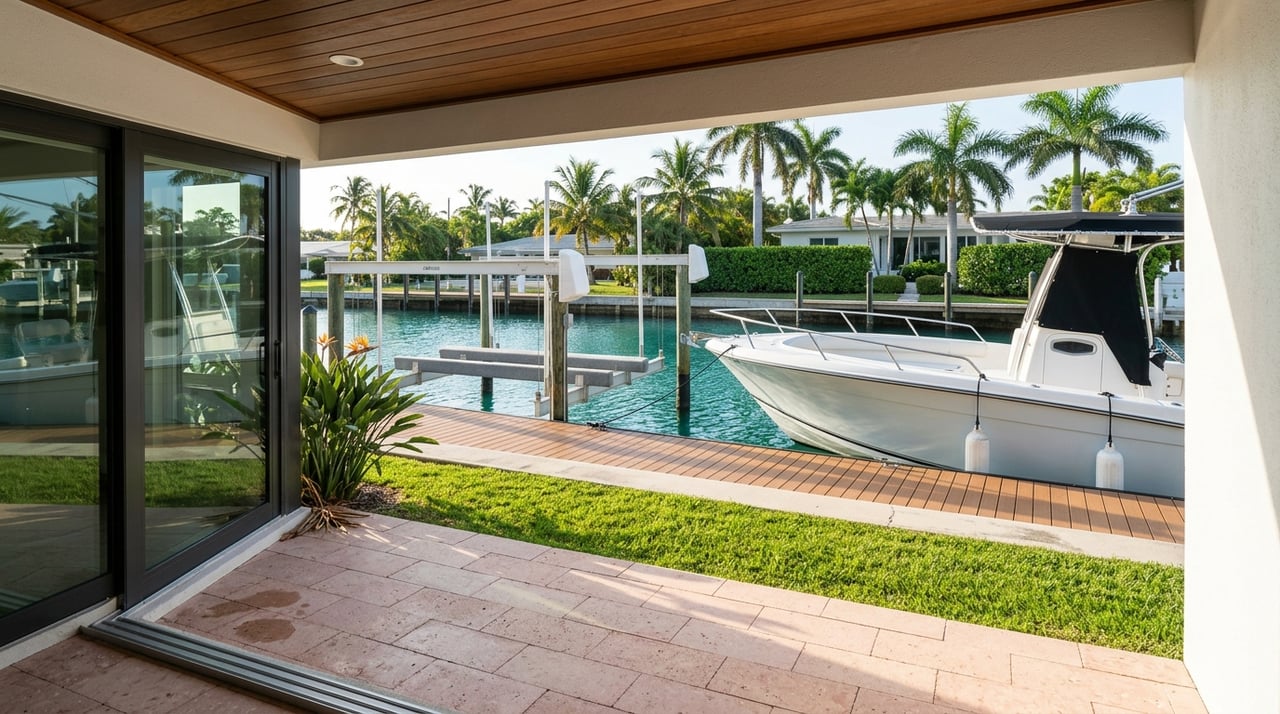
Most waterfront buyers budget for the house, taxes, and insurance, and completely forget the marine engineering holding the backyard together. A seawall isn't permanent; it is a working retaining wall fighting groundwater pressure from your yard, saltwater and wave energy from the bay. On open water, constant wakes and storm chop hammer the wall every day, washing backfill out through hairline cracks until sinkholes start forming in your lawn. Replacing or reinforcing an open-bay seawall requires heavier pilings, taller caps to meet modern flood codes, and riprap boulders at the base just to break up the wave energy. Interior canal walls live a much easier life, though you still want to inspect the cap for rust bleed and structural wear and tear.
The same physics apply to your boat lift. In a calm canal, a standard four-piling cradle lift operates with significantly less lateral stress. On the open bay or ICW, you cannot cut corners. You need deeper-driven, oversized pilings, cross-bracing, and high-speed motors so you aren't stuck hovering in a choppy cross-current waiting for the cradle to come up.
Privacy, Noise, and Storm Surge Exposure
Finally, think carefully about who shares your backyard. If you buy on the open bay, especially along the Venetian Islands, Palm or Star Island, your pool deck is part of Miami’s daily sightseeing tours. Charter boats, party yachts, and sandbar crowds idle right past your seawall with loudspeakers and cameras rolling, and anyone on the water can practically pull right up to your dock. Interior canals feel more like an actual neighborhood; the only people cruising past your house are the folks who live down the street.
Oddly enough, noise works in reverse. On a narrow canal, sound bounces off concrete seawalls and two-story stucco walls like an amphitheater, meaning your neighbor's late-night stereo or a boat generator running across the water echoes straight into your bedroom. On the open bay, wind and wave noise act like natural white noise, drowning out your neighbors and leaving you with just the distant hum of causeway traffic.
When a hurricane tracks toward South Florida, both locations carry their own risks. Open bay lots take direct wind fetch across miles of water, pushing choppy waves right over the seawall. Canals shield your boat from wave action, which is why people treat them as hurricane holes, but narrow dead-end canals can funnel storm surge—trapping wind-driven water at the back of the canal so levels rise higher and faster than they do out on the open bay.
Before you sign a contract on any waterfront home in Miami, look past the staging and the sunset photos. Walk the seawall at dead low tide, look for storm drain outfalls, check which way the afternoon wind blows across the pilings, and come back on a Sunday afternoon when the bay is at its worst. The water will tell you everything the listing won't.
Frequently Asked Questions About Miami Waterfront Homes
Is it better to buy a waterfront home on a canal or the open bay in Miami?
It comes down to how you use the water. If you want effortless docking, calm water for paddleboarding, less wear and tear on your boat lift, and privacy from tour boats, an interior flow-through canal is hard to beat. If you want wide-open water views, more privacy, cooling breezes, immediate channel access with zero idle time, and don't mind heavy boat wakes or higher seawall maintenance, go with the open bay.
What is the difference between a flow-through canal and a dead-end canal?
A flow-through canal connects to the bay or Intracoastal at both ends, allowing natural tidal currents to flush out debris and keep the water clear. A dead-end finger canal terminates at a seawall or turning basin, which traps wind-blown sea grass, runoff, trash and stagnant water during the hotter months.
Are canals safer than the open bay during a Miami hurricane?
Canals protect boats from direct wind-driven waves and rough bay chop, making them popular storm shelters. However, narrow dead-end canals can funnel storm surge, causing water levels to rise higher and faster inside the canal than out on the open bay.
Why do open-bay seawalls and boat lifts cost more to maintain?
Open-bay and ICW properties absorb constant direct wave slap during windy and high traffic days. That requires heavier-duty seawall engineering, riprap erosion protection, deeper-driven lift pilings, and faster lift motors to handle strong cross-currents when docking.